
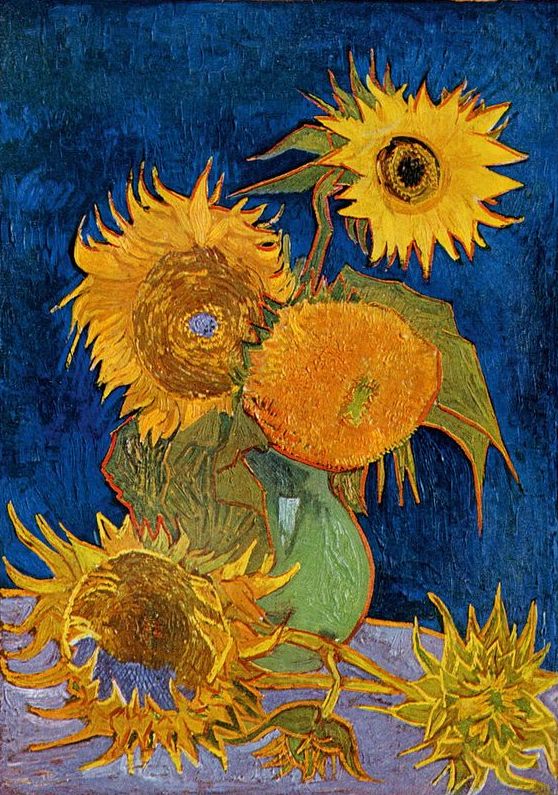
| Still Life: Vase with Five Sunflowers |
| Details | ||
|
Oil on canvas 98.0 x 69.0 cm. Arles: August, 1888 F 459, JH 1560 Destroyed by fire in the Second World War |
||
| History | ||
| Provenance Exhibitions |
||
| Analysis | ||
| See below |
||
|
In August, 1888 Vincent van Gogh began painting a series of works which, as Dr. Jan Hulsker suggests "perhaps more than any other of his paintings, have made him known throughout the world. They are often the only works with which he is identified."1 This series is, of course, the sunflowers.
Van Gogh envisioned his sunflower works as a series and worked diligently on them in anticipation of the arrival in Arles of his friend, Paul Gauguin. In a letter to Emile Bernard written around 18 August 1888 Vincent wrote: "I am thinking of decorating my studio with half a dozen pictures of "Sunflowers", a decoration in which the raw or broken chrome yellows will blaze forth on various backgrounds--blue, from the palest malachite green to royal blue . . ." (B15). Vincent eventually planned a dozen sunflower works to be hung in the Yellow House which he and Gauguin would use for a studio. "I would like to make a decoration for the walls. Nothing but large sunflowers . . . Well, if I carry out that plan, there will be a dozen panels of them. The whole thing will therefore become a symphony in blue and yellow. I work at it every morning from sunrise, for the flowers wilt quickly and it is a matter of doing the whole thing in one go" (526). Unfortunately, Vincent's race against the changing seasons was unsuccessful and he was only able to complete four sunflower works in August, 1888, including the work featured on this page. Without question, the most valuable resource with regards to insights into the development and execution of Van Gogh's works are his letters to his brother, Theo, and others. In his typically detailed and precise manner, Van Gogh describes the origin of the first three works in this series: "I have three canvases on the stocks; 1st, three large sunflowers in a green vase, light background (size 15 canvas) [A]; 2nd, three flowers, one flower which has wilted and lost its leaves and one in bud on a background of royal blue (size 25 canvas) [B]. The last one is light on light and will, I hope, be the best[C]" (526). A few days later Vincent writes in Letter 527: "I am now working on the fourth painting of the sunflowers. This fourth one is a bouquet of fourteen flowers and has a yellow background."[D] The four works mentioned above are noted as "A" through "D" and further details are shown in this table below:
The work featured on this page is surrounded by some degree of confusion--both at the beginning of its short life, as well as at the end:
As noted in Letter 526 cited above, Vincent describes the first two works [A] and [B] as "size 15" and "size 25". The dimensions, however, of F 453 and F 459 are, respectively 73 x 58 cm. and 98 x 69 cm. The De la Faille catalogue raisonné notes: "Not only should the first two rather be called size 20 and size 30 respectively [F 459 might even be called larger than size 30], but F 455 and F 456 [which are indeed size 30 canvases] are not even as large as F 459 which Vincent called a 'size 25 canvas'. If Vincent erroneously used the wrong indications for the first two paintings he mentioned in letter 526, one would at least have expected the third picture, called 'size 30 canvas' to be a bigger one than the second one which he called a 'size 25 canvas'. The editors have not found a solution to this problem."2
There is conflicting information with regards to the ultimate fate the work featured above. Some references list the painting as being destroyed in the Second World War (Walther and Metzger's Van Gogh: The Complete Paintings), for example), whereas other sources instead list it as "destroyed by fire in 1946" (Van Gogh in Arles by Alfred Nemeczek, p. 23). Hulsker's catalogue raisonné only says "Destroyed" and, to make matters worse, the De la Faille catalogue raisonné contradicts itself. In its main catalogue, the De la Faille lists the work as "destroyed by fire during the Second World War" (emphasis mine). In the later provenance and exhibition listings, however, the work is shown as "burnt in war damage 1946" (one year after the war ended). How exactly did this work meet its unfortunate end?
Van Gogh's Still Life: Vase with Five Sunflowers is a remarkable painting. Its part as one integral piece of one of the most well known and beloved series in the history of art is secure. Its loss is, of course, a tragedy for all who appreciate and admire the works of Vincent van Gogh.
1. Jan Hulsker, The New Complete Van Gogh: Paintings, Drawings, Sketches, (p. 352).
|
|
A Brief History of the Painting in Japan
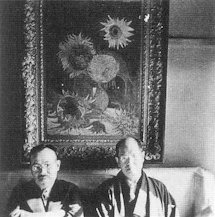
Koyata Yamamoto was born in Osaka, Japan on 19 January, 1886. At the age of 19 he graduated from high school and was hired by the Osaka branch of Satsuma & Co. and assigned to the cotton textile division. In the years to follow he would found his own cotton textile companies. In 1919, the year before he purchased the Van Gogh sunflowers, he founded the Yamamoto Sholen Corporation, managing the Osaka branch as the executive director.
Yamamoto had a great appreciation for the arts and occasionally wrote poetry. In 1915, when Yamamoto was 30-years-old, he read a novel "When He Was Thirty Years Old" by writer and artist Saneatsu Mushanokoji. The novel made such an impression on Yamamoto that he read many more of the author's works and eventually forged a strong friendship with him. It was a result of Mushanokoji's influence, rather than an affinity toward Van Gogh's works, that prompted Yamamoto to purchase the sunflower painting. Mushanokoji (through his friend Moritsu Hosokawa) had arranged the purchase of a Cézanne self-portrait for 20,000 yen and was very interested in acquiring the Van Gogh sunflowers as well, but had been unsuccessful in finding a Japanese buyer. Yamamoto, touched by his friend's passion, agreed to purchase Van Gogh's sunflowers for 20,000 yen. The sunflower painting was shipped from France to Japan on the mail steamer Binna. The steamer departed on 21 May 1920 and arrived in Japan later that year sometime around 12 December. Early in 1921 the painting appeared in the first of only two brief exhibitions in which it would be displayed in Japan. The painting was well received by the Japanese public, especially at the second exhibition in Osaka where it attracted more attention than the many other works on display. Strangely enough, it was the painting's large frame that had a profound impact on its fate. During the Shinanobashi exhibition the unusually heavy frame caused the painting to fall from the wall. The frame was damaged and Yamamoto was so outraged that he never allowed it to be exhibited again. Sadly, the same frame may have had a role to play in the painting's tragic fate. Yamamoto was worried about the heavy bombing in the last years of World War II and asked a bank in Osaka to store the Van Gogh sunflowers painting in its basement. The bank refused on the grounds that the delicate work would be damaged by the basement's humidity. So Yamamoto kept the painting in its usual place on the drawing-room wall of his residence in the Uchide district of Ashiya. In 1945 Ashiya was subject to four air raids by the American military: on 11 May, 5 June, 15 June and finally on 5-6 August. In this final air raid (occurring at the same time as the atomic bombing in Hiroshima), 89 people were killed and 2,833 homes were completely or partly destroyed. Yamamoto's house burned to the ground and Van Gogh's Still Life: Vase with Five Sunflowers was destroyed. There is speculation that the painting's heavy frame may have made it too difficult to move and some believe that this was instrumental in the work's destruction. Yamamoto survived the Ashiya air raids and later in life would support the promotion of poetry groups such as the Ashiya Haiku Society. He left behind a number of his own haiku compositions under the pseudonym Kodo. After World War II he never once mentioned his much loved Van Gogh painting. Koyata Yamamoto died on 25 November 1963 at the age of 77. Source: Vincent and Theo van Gogh (exhibition at the Hokkaido Museum of Modern Art: 5 July - 25 August 2002), Yukihiro Sata/Takashi Kamata/Yayoi Yanagisawa (eds.), Hokkaido Shimbun Press (2002), pp. 270-77. |
| Owner | City | Country | Date acquired |
|---|---|---|---|
| Johanna van Gogh-Bonger | Amsterdam | Netherlands | |
| C.M. van Gogh (J.H. de Bois) | Amsterdam | Netherlands | September, 1908 |
| F. Meyer-Fierz | Zurich | Switzerland | |
| Paul Vallotton Art Gallery | Lausanne | Switzerland | |
| Koyata Yamamoto | Ashiya | Japan | c. 12 December 1920 |
| Destroyed on 5-6 August 1945 by fire in World War II |
| Year | City | Country | Venue | Exhibition Name | Start Date | End Date | No. |
|---|---|---|---|---|---|---|---|
| 1905 | Amsterdam | Netherlands | Stedelijk Museum | Tentoonstelling Vincent van Gogh | 15 July 1905 | 1 August 1905 | 105 |
| 1905 | Utrecht | Netherlands | Vereeniging 'Voor de Kunst' | Tentoonstelling van schilderijen door Vincent van Gogh | 10 September 1905 | 1 October 1905 | 34 |
| 1906 | Rotterdam | Netherlands | Kunstzalen Oldenzeel | Tentoonstelling Vincent van Gogh | 26 January 1906 | 28 February 1906 | 32 |
| 1908 | Munich (1) | Germany | Moderne Kunsthandlung [F.J. Brakl] | Vincent van Gogh | 29 | ||
| 1908 | Frankfurt | Germany | Frankfurter Kunstverein | Vincent van Gogh Ausstellung | 14 June 1908 | 28 June 1908 | 34 |
| 1908 | Zurich | Switzerland | Künstlerhaus | Vincent van Gogh, Cuno Amiet, Hans Emmenegger, Giovanni Giacometti | 10 July 1908 | 26 July 1908 | 23 |
| 1921 | Tokyo | Japan | Hoshi Pharmaceutical Corporation | First Shirakaba Art Museum Exhibition | 5 March 1921 | 13 March 1921 | |
| 1924 | Osaka | Japan | Shinanobashi European Painting Institute | First Shinanobashi European Painting Institute Exhibition | 21 November 1924 | 25 November 1924 |
 Return to Van Gogh paintings page
Return to main Van Gogh Gallery page
 Previous painting