

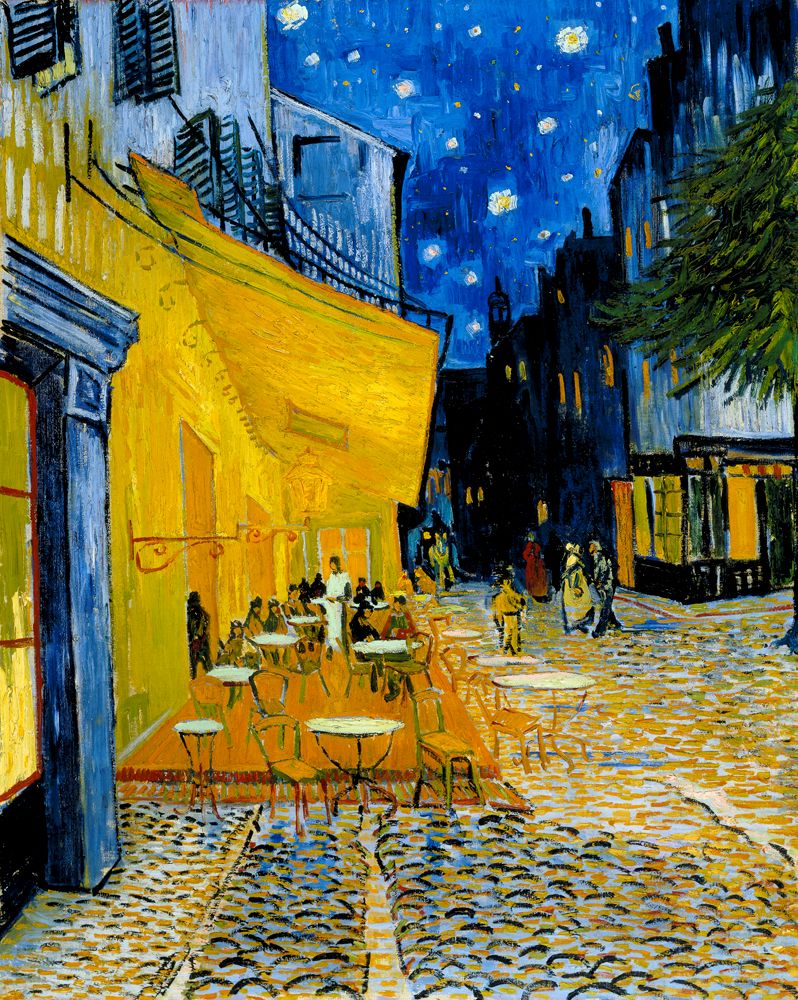
| Cafe Terrace on the Place du Forum, Arles, at Night, The |
|
Details | |
|
Oil on canvas 81.0 x 65.5 cm. Arles: September, 1888 F 467, JH 1580 Otterlo: Kröller-Müller Museum |
||
| History | ||
| Provenance Exhibitions |
||
| Analysis | ||
| See below |
||
|
Vincent van Gogh's The Cafe Terrace stands as one of the painter's most remarkable works. It is also, without question, one of the most famous produced in Van Gogh's brief but prolific career.
This work is the first in a trilogy1 of paintings which feature starlit skies. Starry Night Over the Rhone came within a month, followed by the popular Starry Night painted the next year in Saint-Rémy. An interesting companion to these three can be found in the Portrait of Eugene Boch (painted in the same month as Cafe Terrace and Starry Night Over the Rhone)--note the starry motif in the work's background. Vincent was enthusiastic about The Cafe Terrace and wrote to his sister Wil: In point of fact I was interrupted these days by my toiling on a new picture representing the outside of a night cafe. On the terrace there are tiny figures of people drinking. An enormous yellow lantern sheds its light on the terrace, the house and the sidewalk, and even causes a certain brightness on the pavement of the street, which takes a pinkish violet tone. The gable-topped fronts of the houses in a street stretching away under a blue sky spangled with stars are dark blue or violet and there is a green tree. Here you have a night picture without any black in it, done with nothing but beautiful blue and violet and green, and in these surroundings the lighted square acquires a pale sulphur and greenish citron-yellow colour. It amuses me enormously to paint the night right on the spot. They used to draw and paint the picture in the daytime after the rough sketch. But I find satisfaction in painting things immediately.(W7: 9 and 16 September 1888)
Vincent goes on to tell Wil that there is a description of a similar cafe in the book Bel Ami by Guy de Maupassant: " . . . a starlit night in Paris with the brightly lighted cafes of the Boulevard, and this is approximately the same subject I just painted.".2
Van Gogh's works are often inspired by literary references or by the works of other painters (see his copies after Jean-François Millet). Cafe Terrace has a similar style and compositional structure to Avenue de Clichy in the Evening by Anquetin. Regardless of whether Van Gogh was directly inspired by Anquetin's work, the composition of Cafe Terrace is unique among all of Van Gogh's oeuvre. Note how the lines of composition all point directly to the centre of the work where a horse and carriage are found. Everything seems to be drawn inward, like a vortex, and yet the overall tone suggests tranquillity and not turmoil. The overall scheme is dark, but without the slightest trace of black.
More than one hundred years after Vincent painted it, the Cafe Terrace is still in Arles serving drinks to its thirsty patrons. It's now called the Cafe Van Gogh, appropriately enough, and has been remodelled to appear as it did more than a century ago--yellow-lit awning and all. I stopped and had a cognac when I visited Arles in 1995 (you won't find absinthe on the menu any more) and thought of Vincent, so close by in spirit, working feverishly (but contentedly) under the stars.
|
| Owner | City | Country | Date acquired |
|---|---|---|---|
| Albert Aurier | Paris | France | |
| S. Williame-Aurier | Chateauroux | France | 5 October 1892 |
| H. Kröller-Müller | The Hague | Netherlands | June, 1914 |
| Kröller-Müller Museum | Otterlo | Netherlands | |
| Year | City | Country | Venue | Exhibition Name | Start Date | End Date | No. |
|---|---|---|---|---|---|---|---|
| 1891 | Paris (2) | France | Galerie Le Barc de Bouteville | 1re Exposition des Peintres Impressionnistes et Symbolistes | |
|
76 |
| 1927 | Basel | Switzerland | Kunsthalle | Vincent van Gogh. 143 Werke aus der Sammlung Kröller im Haag | 18 June 1927 | 4 September 1927 | 110 |
| 1927 | Bern | Switzerland | Kunsthalle | Vincent van Gogh. 143 Werke aus der Sammlung Kröller im Haag | 7 September 1927 | 17 October 1927 | 110 |
| 1927 | Brussels | Belgium | Museum voor Moderne Kunst | Vincent van Gogh. 140 werken uit de verzameling Kröller | 5 November 1927 | 4 December 1927 | 110 |
| 1928 | Düsseldorf | Germany | Städtische Kunsthalle | Ausgewählte Kunstwerke aus der Sammlung Frau H. Kröller-Müller, Den Haag | 1 August 1928 | 23 September 1928 | 178 |
| 1928 | Karlsruhe | Germany | Badische Kunsthalle | Vincent van Gogh. 150 Werke aus der Sammlung Kröller-Müller im Haag | 30 September 1928 | 9 December 1928 | 113 |
| 1928-29 | Berlin | Germany | National-Galerie | Vincent van Gogh. 143 Werke aus dem Besitz von Frau Kröller-Müller im Haag | 20 December 1928 | 28 February 1929 | 115 |
| 1929 | Hamburg | Germany | Kunstverein | Vincent van Gogh. Sammlung Kröller-Müller im Haag | 14 March 1929 | 21 May 1929 | 66 |
| 1930 | Amsterdam | Netherlands | Stedelijk Museum | Vincent van Gogh en zijn tijdgenooten | 6 September 1930 | 2 November 1930 | 222 |
| 1935-36 | New York | United States | Museum of Modern Art | Vincent van Gogh | 5 November 1935 | 5 January 1936 | 35 |
| 1936 | Philadelphia | United States | Philadelphia Museum of Art | Vincent van Gogh | 11 January 1936 | 10 February 1936 | 35 |
| 1936 | Boston | United States | Museum of Fine Arts | Vincent van Gogh | 19 February 1936 | 15 March 1936 | 35 |
| 1936 | Cleveland (1) | United States | Cleveland Museum of Art | Vincent van Gogh | 25 March 1936 | 19 April 1936 | 35 |
| 1936 | San Francisco | United States | California Palace of the Legion of Honor | Vincent van Gogh | 28 April 1936 | 24 May 1936 | 35 |
| 1936 | Kansas City | United States | William Rockhill Nelson Gallery of Art and Atkins Museum | Vincent van Gogh | 9 June 1936 | 10 July 1936 | 35 |
| 1936 | Minneapolis | United States | Minneapolis Institute of Arts | Vincent van Gogh | 20 July 1936 | 17 August 1936 | 35 |
| 1936 | Chicago | United States | Art Institute of Chicago | Vincent van Gogh | 26 August 1936 | 23 September 1936 | 35 |
| 1936 | Detroit | United States | Detroit Institute of Arts | Vincent van Gogh | 6 October 1936 | 28 October 1936 | 35 |
| 1945 | The Hague | Netherlands | Pulchri Studio | Den Haag eert de Nederlandse schilders van de 19e eeuw | 25 August 1945 | 30 September 1945 | 33 |
| 1946 | Liège | Belgium | Musée des Beaux-Arts | Vincent van Gogh | 12 October 1946 | 3 November 1946 | 114 |
| 1946 | Brussels | Belgium | Palais des Beaux-Arts | Vincent van Gogh | 9 November 1946 | 19 December 1946 | 114 |
| 1946-47 | Mons | Belgium | Musée des Beaux-Arts | Vincent van Gogh | 27 December 1946 | |
114 |
| 1947 | Paris (1) | France | Musée de l'Orangerie | Vincent van Gogh | 24 January 1947 | 15 March 1947 | 110 |
| 1947 | Geneva | Switzerland | Musée Rath | 172 oeuvres de Vincent van Gogh | 22 March 1947 | 20 April 1947 | 110 |
| 1947 | Basel | Switzerland | Kunsthalle Basel | Vincent van Gogh 1853-1890 | 11 October 1947 | 23 November 1947 | 65 |
| 1947-48 | London | United Kingdom | Tate Gallery | Vincent van Gogh 1853-1890 | 10 December 1947 | 14 January 1948 | 51 |
| 1948 | Birmingham | United Kingdom | City Art Gallery | Vincent van Gogh 1853-1890 | 24 January 1948 | 14 February 1948 | 51 |
| 1948 | Glasgow | Scotland | Art Gallery | Vincent van Gogh 1853-1890 | 21 February 1948 | 14 March 1948 | 51 |
| 1949-50 | New York | United States | Metropolitan Museum of Art | Vincent van Gogh Paintings and Drawings. A Special Loan Exhibition | 21 October 1949 | 15 January 1950 | 82 |
| 1950 | Chicago | United States | Art Institute of Chicago | Vincent van Gogh Paintings and Drawings. A Special Loan Exhibition | 1 February 1950 | 16 April 1950 | 82 |
| 1952 | Milan | Italy | Palazzo Reale | Van Gogh. Dipinti e disegni | 23 February 1952 | 13 May 1952 | 84 |
| 1953 | The Hague | Netherlands | Haags Gemeentemuseum | Vincent van Gogh 1853-1953 | 30 March 1953 | 17 May 1953 | 132 |
| 1953 | Otterlo | Netherlands | Kröller-Müller Museum | Eeuwfeest Vincent van Gogh 1853-1953 | 24 May 1953 | 19 July 1953 | 109 |
| 1953 | Amsterdam | Netherlands | Stedelijk Museum | Eeuwfeest Vincent van Gogh | 23 July 1953 | 20 September 1953 | 109 |
| 1953 | Saint Louis | United States | City Art Museum of Saint Louis | Vincent van Gogh 1853-1890 | 17 October 1953 | 13 December 1953 | 104 |
| 1954 | Toledo | United States | Toledo Museum of Art | Vincent van Gogh 1853-1890 | 7 March 1953 | 30 April 1953 | 104 |
| 1954 | Philadelphia | United States | Philadelphia Museum of Art | Vincent van Gogh 1853-1890 | 2 January 1954 | 28 February 1954 | 104 |
| 1956 | Eindhoven | Netherlands | Stedelijk van Abbemuseum | Vincent van Gogh from the Collection of the Rijksmuseum Kröller-Müller | 28 January 1956 | 12 March 1956 | 36 |
| 1956 | Munich | Germany | Haus der Kunst | Vincent van Gogh | 19 October 1956 | 16 December 1956 | 130 |
| 1957 | Essen | Germany | Villa Hügel | Vincent van Gogh (1853-1890). Leben und Schaffen. Dokumentation Gemälde, Zeichnungen | 16 October 1957 | 15 December 1957 | 302 |
| 1958 | Vienna | Austria | Oesterreichische Galerie | Vincent van Gogh from the Collection Kröller-Müller, Otterlo | |
|
83 |
| 1958 | Tokyo | Japan | Tokyo National Museum | Vincent van Gogh from the Collection Kröller-Müller, Otterlo | 15 October 1958 | 25 November 1958 | 101 |
| 1958 | Kyoto | Japan | Municipal Museum of Art | Vincent van Gogh from the Collection Kröller-Müller, Otterlo | 3 December 1958 | 27 December 1958 | 101 |
| 1959 | Aix-en-Provence | France | Pavillion de Vendôme | Van Gogh en Provence | 3 October 1959 | 30 November 1959 | 14 |
| 1960 | Montreal | Canada | Montreal Museum of Fine Arts | Canada Collects: European Painting 1860-1960 | 6 October 1960 | 6 November 1960 | 40 |
| 1960 | Ottawa | Canada | National Gallery of Canada | Canada Collects: European Painting 1860-1960 | 17 November 1960 | 18 December 1960 | 40 |
| 1960-61 | Winnipeg | Canada | Winnipeg Art Gallery | Vincent van Gogh. Paintings-Drawings | 29 December 1960 | 31 January 1961 | 40 |
| 1961 | Toronto | Canada | Art Gallery of Toronto | Vincent van Gogh. Paintings-Drawings | 10 February 1961 | 12 March 1961 | 40 |
| 1971 | Moscow | Russia | Pushkin Museum | Vincent van Gogh | 15 April 1971 | 30 May 1971 | 75 |
| 1971 | St. Petersburg | Russia | Hermitage | Vincent van Gogh | 13 June 1971 | 31 July 1971 | 75 |
| 1981 | Toronto | Canada | Art Gallery of Ontario | Vincent van Gogh and the Birth of Cloisonism | 24 January 1981 | 22 March 1981 | 22 |
| 1981 | Amsterdam | Netherlands | Van Gogh Museum | Vincent van Gogh and the Birth of Cloisonism | 9 April 1981 | 14 June 1981 | 22 |
| 1990 | Amsterdam | Netherlands | Van Gogh Museum | Vincent van Gogh. Schilderijen | 30 March 1990 | 29 July 1990 | 59 |
| 2004 | Seattle | United States | Seattle Art Museum | From Van Gogh to Mondrian: Modern Art from the Kröller-Müller Museum | 29 May 2004 | 12 September 2004 | |
| 2004-05 | Atlanta (1) | United States | High Museum of Art | From Van Gogh to Mondrian: Modern Art from the Kröller-Müller Museum | 19 October 2004 | 16 January 2005 | |
| 2005 | Tokyo | Japan | National Museum of Modern Art | Van Gogh in Context | 23 March 2005 | 22 May 2005 | |
| 2005 | Osaka | Japan | National Museum of Modern Art | Van Gogh in Context | 31 May 2005 | 18 July 2005 | |
| 2005 | Nagoya | Japan | Aichi Prefectural Museum of Art | Van Gogh in Context | 26 July 2005 | 25 September 2005 | |
Note: This page is also available in Italian and Russian.
 Return to Van Gogh paintings page
Return to main Van Gogh Gallery page
 Previous painting