

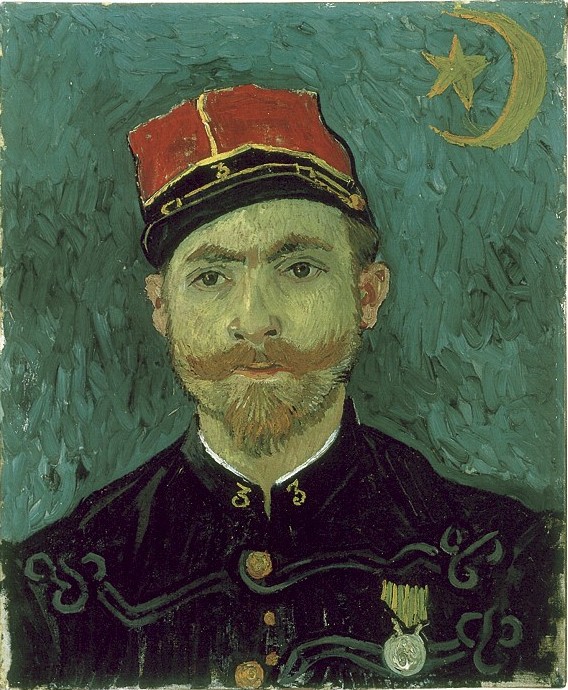
| Portrait of Milliet, Second Lieutenant of the Zouaves |
| Details | ||
|
Oil on canvas 60.0 x 49.0 cm. Arles: late September, 1888 F 473, JH 1588 Otterlo: Kröller-Müller Museum |
||
| History | ||
| Provenance Exhibitions |
||
| Analysis | ||
| See below |
||
|
This painting depicts Paul-Eugène Milliet, second lieutenant in the third regiment of the Zouaves. Milliet and Vincent van Gogh became friends in 1888 when both men were in Arles, France.
Paul-Eugène Milliet was the son of a military policeman and lived most of his life as a soldier. Milliet grew up in army barracks and his military career had been progressing well by the time he was temporarily stationed in Arles in 1888. Milliet's regiment had just returned from Tonkin (then French Indochina, now the region around the Gulf of China in Vietnam). During that campaign Milliet had contracted an illness and looked forward to convalescing in the south of France. In August Milliet made a brief journey to Paris and was entrusted with thirty six of Vincent's studies to give to the artist's brother, Theo. He stayed in Arles for the rest of the summer and into early autumn, finally leaving around 1 November for Algeria. In the years to follow Milliet had a distinguished career in the military, serving in Tunisia, Algeria, Morocco and during the First World War. He retired with the rank of lieutenant-colonel and had received the decoration of Commander of the Légion d'Honneur. In 1930 a writer, Pierre Weiller, was looking for a new apartment in Paris and went to meet with his prospective landlady. Upon arrival Weiller was met by the landlady's husband, none other than Paul-Eugène Milliet, by then retired from the military. Weiller quickly recognized Milliet and interviewed him about his acquaintance with Vincent van Gogh. He later wrote an article "We've Tracked Down Van Gogh's Zouave" based on that interview.1 Milliet died in Paris during the German occupation of World War II.
The Zouaves were a group of light infantry personnel in the French army. The Zouave soldiers were mainly from Algeria and, though European, their uniforms showed arabesque influences. In addition to his portrait of Milliet, Vincent van Gogh would depict another Zouave in five other works:
Interestingly, there was an American offshoot of the Zouaves that few know about today. During the American Civil War, regiments on both sides often chose special names and uniforms for themselves. On the Union side there were a number of regiments that modeled themselves after France's Zouaves. They wore short blue jackets, yellow shirts and red pantaloons and were often seen in battle around 1861. By 1863, however, the American Zouave regiments became more uncommon.
Paul-Eugène Milliet was atypical of many who chose a life long career in the military. Milliet had a keen interest in art and was enthusiastic about painting and drawing. It was only natural that he and Van Gogh would gravitate toward one another in Arles. Van Gogh wrote to Emile Bernard:
Vincent encouraged Milliet in his work and was impressed enough to write to Theo and ask him to send Cassagne's instructional book ABCD du dessin in order to assist with his tutelage of the young Zouave. Throughout the summer of 1888 Vincent van Gogh and Paul-Eugène Milliet spent much time together, exploring the countryside and discussing art. Van Gogh recalled one pleasant day:
Vincent enjoyed his time with Milliet, finding in him a friend that he could share ideas with. Still, the pair's relationship was somewhat turbulent--a frequent pattern accompanying Van Gogh's friendships. Early in his career, Vincent van Gogh enjoyed learning from his cousin by marriage, the painter Anton Mauve. Van Gogh very much valued their time painting together, but he was extremely sensitive to criticism and this had a detrimental effect on their relationship. Similarly, Van Gogh took great pleasure from his friendship with painter Anthon van Rappard, but they too would eventually have a falling out when Rappard criticized Van Gogh's first great painting The Potato Eaters. The relationship between Van Gogh and Milliet would follow a similar path. In the Weiller interview Milliet described his disapproval of Van Gogh's technique (somewhat irrationally, given that Van Gogh's works had become very successful by the time of the interview):
Still, Milliet maintained a pleasant friendship with Van Gogh right up until the time of his departure for Algeria. Milliet further commented: "He had faith, a faith in his talent, a somewhat blind faith. Pride. His constitution didn't seem to me very strong. But, on the whole, a good friend, not a bad guy . . . ."
The portrait above is a fairly straightforward study of the subject--very typical of similar portraits executed during Van Gogh's Arles period. It's likely that Van Gogh painted the work quickly because he lamented that Milliet "poses badly" (Letter 541a). Milliet is seen in his military uniform and wears a commemorative medal from his expedition to Tonkin. The background is a deep green of broad and forceful brushstrokes. The relatively plain background (plain, if compared with the more floral and ornate backgrounds found in, say, Portrait of the Postman Joseph Roulin from the same period). The only flourish is the star and crescent moon symbol seen in the upper right hand corner. This symbol was the coat of arms for Milliet's Zouave regiment and serves to further define the portrait's subject. In gratitude for sitting for him and for delivering completed works to Theo, Van Gogh rewarded Milliet with a study (see Letter 561), but the fate of that study is unknown.
Footnotes
1. Reprinted in Susan Stein's collection, pages 108-111 (see References below).
1. Jan Hulsker, Vincent and Theo Van Gogh: A Dual Biography (Fuller Technical Publications, 1990). |
| Owner | City | Country | Date acquired |
|---|---|---|---|
| Johanna van Gogh-Bonger | Amsterdam | Netherlands | |
| Paul Cassirer Art Gallery | Berlin | Germany | |
| H. Kröller-Müller | The Hague | Netherlands | August, 1912 |
| Kröller-Müller Museum | Otterlo | Netherlands | |
| Year | City | Country | Venue | Exhibition Name | Start Date | End Date | No. |
|---|---|---|---|---|---|---|---|
| 1908 | Berlin (4) | Germany | Paul Cassirer | |
|
|
49 |
| 1908 | Paris (1) | France | Galerie Bernheim-Jeune | Cent tableaux de Vincent van Gogh | 6 January 1908 | 1 February 1908 | 51 |
| 1908 | Berlin (1) | Germany | Ausstellungshaus am Kurfürstendamm | VII. Ausstellung | 5 March 1908 | 22 March 1908 | 17 |
| 1908 | Frankfurt | Germany | Frankfurter Kunstverein | Vincent van Gogh Ausstellung | 14 June 1908 | 28 June 1908 | 56 |
| 1908 | Amsterdam | Netherlands | Kunstzalen C.M. van Gogh | Vincent van Gogh tentoonstelling | 3 September 1908 | 24 September 1908 | 45 |
| 1909 | Munich | Germany | Moderne Kunsthandlung [F.J. Brakl] | Vincent van Gogh [French Period] | |
|
27 |
| 1910 | Dresden | Germany | Galerie Ernst Arnold | Vincent van Gogh | |
|
--- |
| 1910 | Chemnitz | Germany | Kunstsalon Gerstenberger | Vincent van Gogh | |
|
--- |
| 1910 | Frankfurt | Germany | Frankfurter Kunstverein | Vincent van Gogh | |
|
--- |
| 1910 | Berlin (1) | Germany | Paul Cassirer | Ausstellung Vincent van Gogh 1853-1890 | 25 October 1910 | 20 November 1910 | 52 |
| 1911-12 | Hamburg | Germany | Galerie Commeter | |
10 November 1911 | |
18 |
| 1912 | Breslau/Dresden | Germany | Galerie Ernst Arnold | Ausstellung Vincent van Gogh 1853-1890 | |
|
3 |
| 1912 | Cologne | Germany | Städtische Ausstellungshalle am Aachener Tor | Internationale Kunstausstellung des Sonderbundes Westdeutscher Kunstfreunde und Künstler zu Köln | 25 May 1912 | 30 September 1912 | 56 |
| 1913 | The Hague | Netherlands | Gebouw Lange Voorhout | Werken van Vincent van Gogh | 1 July 1913 | 1 September 1913 | 129 |
| 1914 | Antwerp | Belgium | Zaal Comité voor Artistieke Werking | L'art contemporain. Salon 1914 / Kunst van Heden, Tentoonstelling 1914 | 7 March 1914 | 5 April 1914 | 46 |
| 1927 | Basel | Switzerland | Kunsthalle | Vincent van Gogh. 143 Werke aus der Sammlung Kröller im Haag | 18 June 1927 | 4 September 1927 | 101 |
| 1927 | Bern | Switzerland | Kunsthalle | Vincent van Gogh. 143 Werke aus der Sammlung Kröller im Haag | 7 September 1927 | 17 October 1927 | 101 |
| 1927 | Brussels | Belgium | Museum voor Moderne Kunst | Vincent van Gogh. 140 werken uit de verzameling Kröller | 5 November 1927 | 4 December 1927 | 101 |
| 1928 | Düsseldorf | Germany | Städtische Kunsthalle | Ausgewählte Kunstwerke aus der Sammlung Frau H. Kröller-Müller, Den Haag | 1 August 1928 | 23 September 1928 | 168 |
| 1928 | Karlsruhe | Germany | Badische Kunsthalle | Vincent van Gogh. 150 Werke aus der Sammlung Kröller-Müller im Haag | 30 September 1928 | 9 December 1928 | 103 |
| 1928-29 | Berlin | Germany | National-Galerie | Vincent van Gogh. 143 Werke aus dem Besitz von Frau Kröller-Müller im Haag | 20 December 1928 | 28 February 1929 | 108 |
| 1929 | Hamburg | Germany | Kunstverein | Vincent van Gogh. Sammlung Kröller-Müller im Haag | 14 March 1929 | 21 May 1929 | 58 |
| 1930 | Amsterdam | Netherlands | Stedelijk Museum | Vincent van Gogh en zijn tijdgenooten | 6 September 1930 | 2 November 1930 | 230 |
| 1935-36 | New York | United States | Museum of Modern Art | Vincent van Gogh | 5 November 1935 | 5 January 1936 | 58 |
| 1936 | Philadelphia | United States | Philadelphia Museum of Art | Vincent van Gogh | 11 January 1936 | 10 February 1936 | 58 |
| 1936 | Boston | United States | Museum of Fine Arts | Vincent van Gogh | 19 February 1936 | 15 March 1936 | 58 |
| 1936 | Cleveland (1) | United States | Cleveland Museum of Art | Vincent van Gogh | 25 March 1936 | 19 April 1936 | 58 |
| 1936 | San Francisco | United States | California Palace of the Legion of Honor | Vincent van Gogh | 28 April 1936 | 24 May 1936 | 58 |
| 1936 | Kansas City | United States | William Rockhill Nelson Gallery of Art and Atkins Museum | Vincent van Gogh | 9 June 1936 | 10 July 1936 | 58 |
| 1936 | Minneapolis | United States | Minneapolis Institute of Arts | Vincent van Gogh | 20 July 1936 | 17 August 1936 | 58 |
| 1936 | Chicago | United States | Art Institute of Chicago | Vincent van Gogh | 26 August 1936 | 23 September 1936 | 58 |
| 1936 | Detroit | United States | Detroit Institute of Arts | Vincent van Gogh | 6 October 1936 | 28 October 1936 | 58 |
| 1946 | Liège | Belgium | Musée des Beaux-Arts | Vincent van Gogh | 12 October 1946 | 3 November 1946 | 116 |
| 1946 | Brussels | Belgium | Palais des Beaux-Arts | Vincent van Gogh | 9 November 1946 | 19 December 1946 | 116 |
| 1946-47 | Mons | Belgium | Musée des Beaux-Arts | Vincent van Gogh | 27 December 1946 | |
116 |
| 1947 | Paris (1) | France | Musée de l'Orangerie | Vincent van Gogh | 24 January 1947 | 15 March 1947 | 117 |
| 1947 | Geneva | Switzerland | Musée Rath | 172 oeuvres de Vincent van Gogh | 22 March 1947 | 20 April 1947 | 117 |
| 1947 | Basel | Switzerland | Kunsthalle Basel | Vincent van Gogh 1853-1890 | 11 October 1947 | 23 November 1947 | 67 |
| 1947-48 | London | United Kingdom | Tate Gallery | Vincent van Gogh 1853-1890 | 10 December 1947 | 14 January 1948 | 52 |
| 1948 | Birmingham | United Kingdom | City Art Gallery | Vincent van Gogh 1853-1890 | 24 January 1948 | 14 February 1948 | 52 |
| 1948 | Glasgow | Scotland | Art Gallery | Vincent van Gogh 1853-1890 | 21 February 1948 | 14 March 1948 | 52 |
| 1949-50 | New York | United States | Metropolitan Museum of Art | Vincent van Gogh Paintings and Drawings. A Special Loan Exhibition | 21 October 1949 | 15 January 1950 | 81 |
| 1950 | Chicago | United States | Art Institute of Chicago | Vincent van Gogh Paintings and Drawings. A Special Loan Exhibition | 1 February 1950 | 16 April 1950 | 81 |
| 1950 | Leiden | Netherlands | De Lakenhal | Van Fantin Latour tot Picasso [from the Collection of the Rijksmuseum Kröller-Müller] | 14 October 1950 | 26 November 1950 | 22 |
| 1951 | Enschede | Netherlands | Rijksmuseum Twenthe | Van Fantin Latour tot Picasso [from the Collection of the Rijksmuseum Kröller-Müller] | 6 January 1951 | 11 February 1951 | 22 |
| 1951 | Groningen | Netherlands | Museum voor Oudheden | Van Fantin Latour tot Picasso [from the Collection of the Rijksmuseum Kröller-Müller] | 16 February 1951 | 11 March 1951 | 22 |
| 1951 | Leeuwarden | Netherlands | Friesch Museum | Van Fantin Latour tot Picasso [from the Collection of the Rijksmuseum Kröller-Müller] | 17 March 1951 | 8 April 1951 | 22 |
| 1952 | Milan | Italy | Palazzo Reale | Van Gogh. Dipinti e disegni | 23 February 1952 | 13 May 1952 | 85 |
| 1953 | The Hague | Netherlands | Haags Gemeentemuseum | Vincent van Gogh 1853-1953 | 30 March 1953 | 17 May 1953 | 133 |
| 1953 | Otterlo | Netherlands | Kröller-Müller Museum | Eeuwfeest Vincent van Gogh 1853-1953 | 24 May 1953 | 19 July 1953 | 108 |
| 1953 | Amsterdam | Netherlands | Stedelijk Museum | Eeuwfeest Vincent van Gogh | 23 July 1953 | 20 September 1953 | 108 |
| 1953 | Saint Louis | United States | City Art Museum of Saint Louis | Vincent van Gogh 1853-1890 | 17 October 1953 | 13 December 1953 | 106 |
| 1954 | Toledo | United States | Toledo Museum of Art | Vincent van Gogh 1853-1890 | 7 March 1953 | 30 April 1953 | 106 |
| 1954 | Philadelphia | United States | Philadelphia Museum of Art | Vincent van Gogh 1853-1890 | 2 January 1954 | 28 February 1954 | 106 |
| 1956 | Eindhoven | Netherlands | Stedelijk van Abbemuseum | Vincent van Gogh from the Collection of the Rijksmuseum Kröller-Müller | 28 January 1956 | 12 March 1956 | 37 |
| 1957 | Essen | Germany | Villa Hügel | Vincent van Gogh (1853-1890). Leben und Schaffen. Dokumentation Gemälde, Zeichnungen | 16 October 1957 | 15 December 1957 | 304 |
| 1958 | San Francisco | United States | M.H. de Young Memorial Museum | Vincent van Gogh. Paintings and Drawings | 6 October 1958 | 30 November 1958 | 48 |
| 1958-59 | Los Angeles | United States | Los Angeles County Museum of Art | Vincent van Gogh. Paintings and Drawings | 10 December 1958 | 18 January 1959 | 48 |
| 1959 | Portland | United States | Portland Art Museum | Vincent van Gogh. Paintings and Drawings | 28 January 1959 | 1 March 1959 | 48 |
| 1959 | Seattle | United States | Seattle Art Museum | Vincent van Gogh. Paintings and Drawings | 7 March 1959 | 19 April 1959 | 48 |
| 1962 | Warsaw | Poland | Muzeum Narodowe | Vincent van Gogh. Obrazy i rysunki. Wystawa dziel ze zbiorow muzeow holenderskich | 8 October 1962 | 18 October 1962 | 66 |
| 1962-63 | Tel Aviv | Israel | Tel Aviv Museum | Vincent van Gogh | 30 December 1962 | 14 February 1963 | 76 |
| 1963 | Haifa | Israel | Museum of Modern Art | Vincent van Gogh | 20 February 1963 | 20 March 1963 | 76 |
| 1966 | Belgrade | Yugoslavia | Narodni Muzej | Vincent van Gogh: Collection Kröller-Müller | 30 October 1966 | 20 December 1966 | 67 |
| 1971 | Moscow | Russia | Pushkin Museum | Vincent van Gogh | 15 April 1971 | 30 May 1971 | 76 |
| 1971 | St. Petersburg | Russia | Hermitage | Vincent van Gogh | 13 June 1971 | 31 July 1971 | 76 |
| 1980 | Mons | Belgium | Musée des Beaux-Arts | Van Gogh et la Belgique | 3 October 1980 | 30 November 1980 | 40 |
| 1984 | New York | United States | Metropolitan Museum of Art | Van Gogh in Arles | 18 October 1984 | 30 December 1984 | 100 |
| 1985 | Tokyo | Japan | National Museum of Western Art | Vincent van Gogh | 12 October 1985 | 8 December 1985 | 22 |
| 1985-86 | Nagoya | Japan | Nagoya City Museum | Vincent van Gogh | 21 December 1985 | 2 February 1986 | 22 |
| 1986 | Osaka | Japan | National Museum of Art | Vincent van Gogh from Dutch Collections. Religion, Humanity, Nature | 21 February 1986 | 31 March 1986 | 34 |
| 1988 | Rome | Italy | Galleria Nationale d'Arte Moderna | Vincent van Gogh | 28 January 1988 | 4 April 1988 | 35 |
| 1989 | Arles | France | Ancient Hôpital Van Gogh | Van Gogh et Arles | 18 January 1989 | 15 May 1989 | 28 |
| 1990 | Amsterdam | Netherlands | Van Gogh Museum | Vincent van Gogh. Schilderijen | 30 March 1990 | 29 July 1990 | 57 |
| 1995-96 | Yokohama | Japan | Yokohama Museum of Art | Vincent van Gogh Collection from the Kröller-Müller Museum, Otterlo, The Netherlands | 9 December 1995 | 11 February 1996 | 57 |
| 1996 | Nagoya | Japan | City Art Museum | Vincent van Gogh Collection from the Kröller-Müller Museum, Otterlo, The Netherlands | 17 February 1996 | 22 March 1996 | 57 |
| 1999-2000 | Tokyo | Japan | Bunkamura Museum of Art | Vincent van Gogh from the Kröller-Müller Museum | 19 November 1999 | 23 January 2000 | 58 |
| 2000 | Fukuoka | Japan | Fukuoka Art Museum | Vincent van Gogh from the Kröller-Müller Museum | 1 February 2000 | 23 March 2000 | 58 |
| 2001 | Saint Louis | United States | St. Louis Art Museum | Vincent van Gogh and the Painters of the Petit Boulevard | 17 February 2001 | 13 May 2001 | --- |
| 2001 | Frankfurt | Germany | Städelsches Kunstinstitut und Städtische Galerie | Vincent van Gogh and the Painters of the Petit Boulevard | 8 June 2001 | 2 September 2001 | --- |
| 2005 | Tokyo | Japan | National Museum of Modern Art | Van Gogh in Context | 23 March 2005 | 22 May 2005 | |
| 2005 | Osaka | Japan | National Museum of Modern Art | Van Gogh in Context | 31 May 2005 | 18 July 2005 | |
| 2005 | Nagoya | Japan | Aichi Prefectural Museum of Art | Van Gogh in Context | 26 July 2005 | 25 September 2005 | |
| 2005-06 | Brescia | Italy | Museo di Santa Giulia | Gauguin-Van Gogh: The Adventure of the New Color | 22 October 2005 | 26 March 2006 | 87 |
 Return to Van Gogh paintings page
Return to main Van Gogh Gallery page
 Previous painting
